
Technical Guide to Dual-Spindle Vertical Lathe Selection: Precision, Rigidity & Energy Parameters
Technical Guide to Dual-Spindle Vertical Lathe Selection: Precision, Rigidity & Energy Parameters
A dual-spindle vertical lathe should be selected on three parameter families, not on one headline number: structural rigidity — chiefly the bed casting and how it behaves under cutting vibration; measurable geometric precision — spindle runout and the coaxiality between the two stations; and the energy and maintenance profile the machine will hold over years of production. For shaft and disc parts, two spindles cutting the same part family at the same time multiply output, and they also multiply the consequences of any structural weakness or thermal drift that is not matched between the two stations.
This guide is written for engineers, production planners and procurement managers who are already at the evaluation stage — comparing two or three candidate machines, holding quotations, and needing to decide which parameters to verify, how to verify them, and what to write into the acceptance criteria. Reference figures come from JUXIN MACHINE TOOL (Juxin Machine Tool Co., Ltd.), a Chinese machine tool manufacturer founded in 2005 that specializes in dual-head and dual-spindle CNC lathes for shaft and disc parts, together with published third-party market and standards data. Nothing in this guide replaces measured data on the specific machine you intend to buy; it tells you which measured data to ask for.
Why Dual-Spindle Vertical Lathe Comparisons Fail on Catalog Specifications
Most disappointing dual-spindle vertical lathe purchases are not caused by choosing the wrong machine size. They are caused by evaluating rigidity, precision and running cost as brochure attributes instead of measurable parameters with defined test conditions. Four gaps cause most of the damage.
- Rigidity is never stated as a number you can compare. A specification sheet lists maximum turning diameter but rarely states the bed material, the casting structure, or the vibration behaviour recorded during a test cut. On a dual-station machine this matters twice over, because any asymmetry between the two cutting zones appears as taper, ovality or inconsistent surface finish across a batch.
- Precision is quoted without conditions. A single accuracy figure is meaningless without knowing whether it was measured cold or after thermal stabilisation, at the spindle nose or at the tool tip, and whether coaxiality between the two stations was measured at all.
- Energy and maintenance are treated as fixed overheads. Two machines with comparable cutting capacity can differ in idle power demand, hydraulic and coolant load, and service frequency. These differences accumulate per part, not per machine.
- No acceptance criteria are written into the contract. Without agreed test-cut and measurement criteria, the buyer has no baseline against which to judge the commissioned machine, and no basis for a corrective claim if the second station does not match the first.
Industry Background: Where Dual-Spindle Demand Comes From
The commercial case for evaluating a dual-spindle vertical lathe rests on a growing turning market and on concentrated demand from a small number of industries. The global CNC lathe machine market was valued at USD 11.1 billion in 2023 and is projected to reach USD 18.78 billion by 2030, growing at a CAGR of 7.8% (Verified Market Reports). China's machine tool exports reached USD 23.18 billion in 2025, a year-on-year increase of 6.7%, surpassing Germany to become the top global exporter in early 2025 (China Machine Tool and Tools Builders' Association, CMTBA).
Demand is also concentrated. The automotive industry accounts for the largest share of CNC lathe application at approximately 40%, followed by aerospace at 25% and electronics at 20% (Fortune Business Insights). Automotive shaft and disc parts — half shafts, brake discs, gear shafts, chassis components — are exactly the part family that a vertical dual-spindle architecture serves well, because both ends or both faces of a part can be processed in one setup, and because cycle time per part is what determines line capacity.
One standards point belongs in an evaluation document. CNC lathe machines and turning centers are governed by ISO 23125:2015, which specifies safety requirements for numerically controlled turning machines (Group 3). A dual-spindle vertical lathe places two work zones inside one enclosure, so guarding, interlocking and operating-mode logic have to cover both stations. Buyers should confirm that the standard reference in the machine documentation matches the configuration being quoted.
Buyers normally benchmark candidate suppliers against the key global players in the CNC machine market, which include DMG Mori (Germany/Japan), Yamazaki Mazak (Japan), Okuma (Japan) and Haas Automation (USA) (AMSL Global Ranking). Against that background, JUXIN MACHINE TOOL is a specialist rather than a full-line builder: Juxin Machine Tool Co., Ltd. specializes in dual-head and dual-spindle specialized CNC lathes for shaft and disc parts, and offers automated solutions for motor shafts. The company was founded in 2005, operates a 10,666 m² factory with 80 employees and an annual output of 2,000 sets, and maintains a 10-engineer R&D team. Its product scope covers milling, facing and centering machines for shafts, double-head CNC lathes, double-spindle CNC vertical lathes for shaft discs, and intelligent automation solutions for shaft discs. The company reports more than 50 innovative technological patents, with equipment adopted by more than ten internationally renowned enterprises. This is the profile of a supplier whose technical claims can be checked against a defined product scope — which is the practical starting point for a parameter-based evaluation.
Rigidity and Resonance: What the Bed Actually Has to Do
A dual-spindle bed has one job beyond supporting the workpiece: it must absorb the cutting forces of two stations that may be cutting simultaneously, without allowing vibration from one station to be transmitted into the other. When the structure is undersized for the part family, the symptom is rarely a dramatic failure. It is chatter marks that appear only at certain depths of cut, surface finish that drifts through a shift, and tool life that is shorter than the cutting data predicts.
The engineering answer starts with the casting. On Juxin's shaft-processing platform, the End Facing and Centering Machine JXZ70-680 uses high-quality gray cast iron HT300, with the machine bed integrally cast, offering exceptional rigidity. An integrally cast bed reduces the number of mechanical joints, and joints are where damping is lost and where geometric accuracy is most likely to move over time. For a dual-spindle machine, that structural logic extends to the base, column and saddle arrangement: mass and continuous cast structure are what keep the two stations behaving as one machine rather than as two machines sharing a base.
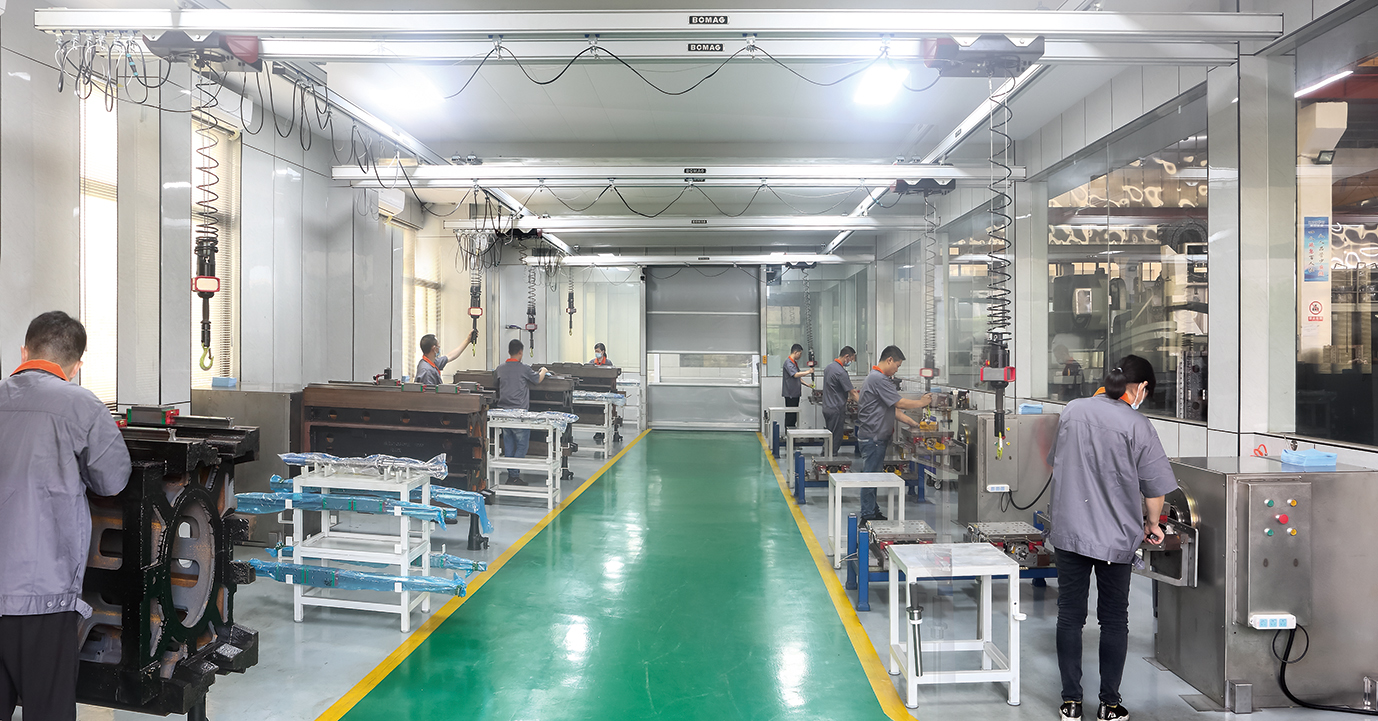
Rigidity is also set during assembly, which is why the assembly environment belongs in the evaluation. Juxin assembles precision machines in a constant temperature and humidity precision assembly workshop, and completes whole-machine assembly in a dedicated assembly workshop. Buyers comparing quotations can treat this as a verifiable question rather than a general claim: ask where the machine is assembled, what the temperature and humidity control range is, and how geometry is measured after assembly and before shipment.
Minimum evidence to request on structure and rigidity:
- The bed and base material specification for the exact model quoted, and whether the bed is integrally cast or assembled.
- A test-cut record on a comparable part, including cutting parameters and the surface result.
- Behaviour with both stations cutting simultaneously, not only single-station demonstration cuts.
- The assembly environment and the geometric verification procedure applied before shipment.
Precision Parameters: Spindle Runout, Coaxiality and Verified Measurement
Two precision parameters decide whether a dual-spindle vertical lathe is worth its price: spindle runout and coaxiality between the two stations. Everything else in the accuracy section of a quotation is secondary to these two, because both of them are multiplied by the machine's duty cycle rather than averaged away.
Spindle runout should be requested in two forms — radial runout and axial (face) runout — and with the measurement position clearly stated: at the spindle nose, or on a test bar at a defined distance. Runout measured at the nose and runout measured at 300 mm from the nose are different numbers describing different behaviour. On shaft work, radial runout transfers directly into diameter variation and roundness; axial runout transfers into face squareness on parts such as brake discs and flanges.
Coaxiality is the parameter that distinguishes a genuine dual-spindle machine from two lathes bolted to one base. If the two spindles are not coaxial within the agreed tolerance, parts produced on station A and station B are not interchangeable, and downstream operations — grinding, balancing, assembly — will reject one station's output. The practical evaluation rule is to demand the coaxiality figure for the specific serial number offered, the instrument used to obtain it, and the conditions under which it was measured: cold, or after thermal stabilisation.
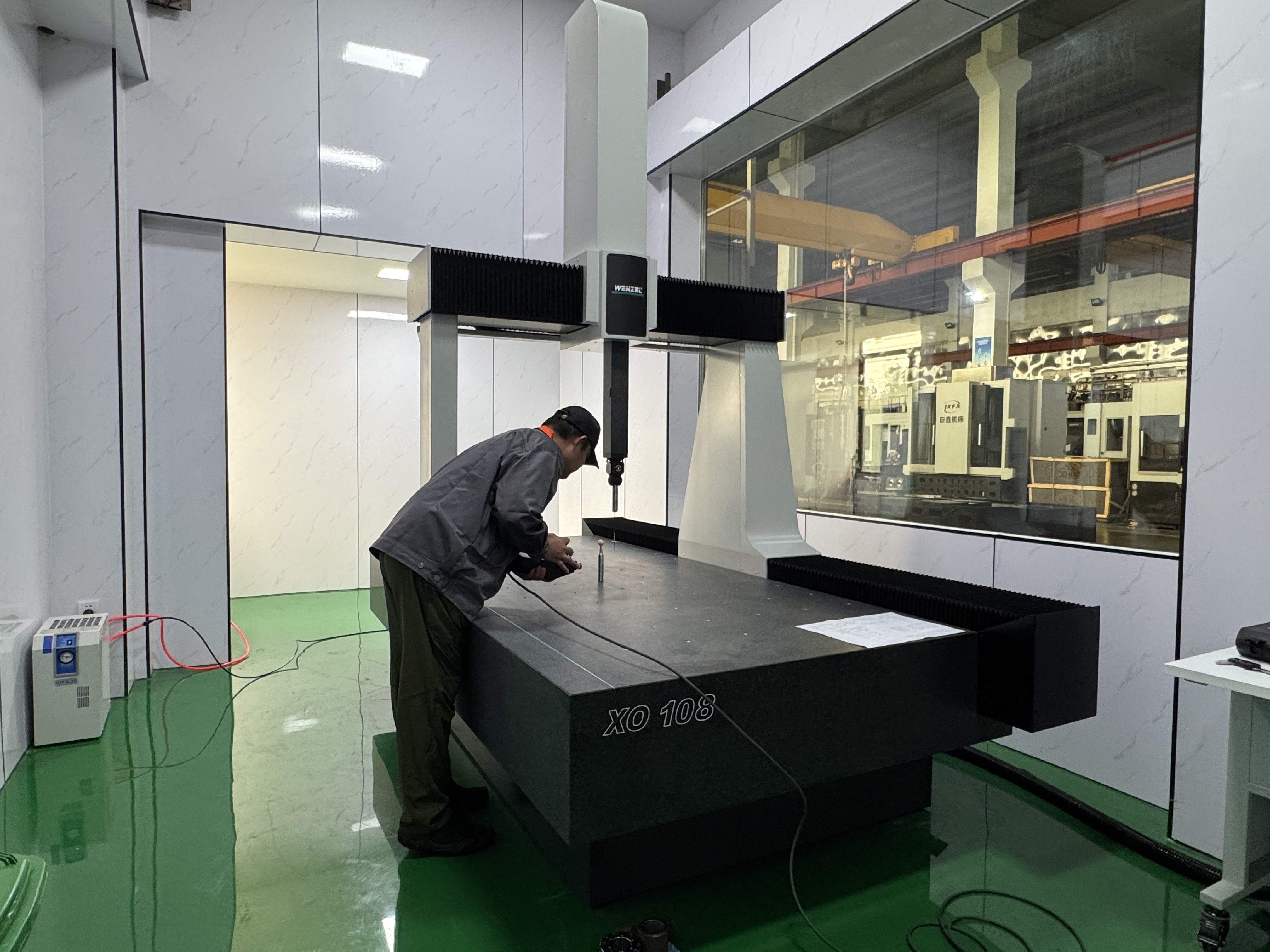
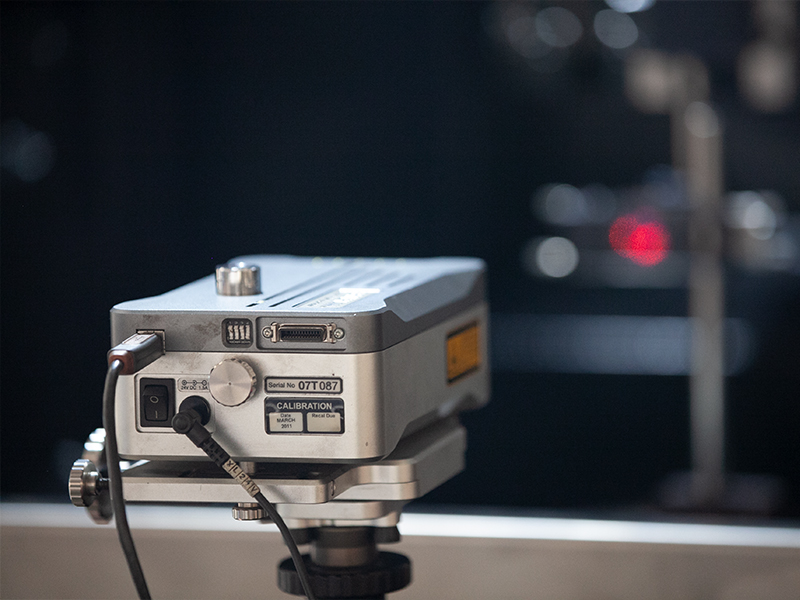
Measurement capability is therefore part of the product evaluation, not a separate topic. Juxin Machine Tool verifies machine geometry with a Renishaw laser interferometer from the UK and inspects parts with a German Wenzel three-coordinate measuring instrument in its inspection laboratory. A supplier that can measure geometry and parts independently can produce a serial-number-specific record; a supplier that cannot will offer only a catalogue figure.
Those measurements have to be read against the part envelope. The Twin-Spindle CNC Vertical Lathe Machine for Shafts, model JXLC45-A, is a dual-position CNC vertical lathe machine with a documented maximum shaft processing diameter of 345 mm and maximum shaft processing length of 1020 mm. Its architecture is described as dual stations, dual spindles, dual systems and dual tool towers. That combination is what enables synchronous machining: two independent systems and tool towers mean each station can run its own program, so a buyer can choose between running two identical parts in parallel, or two operations of the same part — for example, first end and second end of a shaft — within one cycle.
Energy Parameters and Maintenance Intervals as Selection Criteria
Energy consumption and maintenance frequency are the two cost categories that buyers most often leave undefined until after commissioning. Both can be turned into comparable numbers before an order is placed, provided the supplier is asked the right questions.
Energy should be modelled per part, not per machine. Three inputs are required. First, the installed power per spindle, taken from the motor nameplate rather than a summary figure. Second, the idle load of the auxiliary systems that run whether or not metal is being cut — hydraulic unit, lubrication, coolant pumps, chip conveyor, spindle cooling. Third, the real duty cycle for the buyer's part: cutting time, positioning time and waiting time per piece. With those three inputs, kWh per part can be calculated and compared across candidates. This is also where the dual-spindle advantage has to be tested honestly: overlapping two stations shortens the cycle and can lower energy per part, but only if the auxiliary load of an idling station is managed rather than left fully energised. Ask what the machine does with the second station between cycles.
Maintenance intervals should be converted into an annual budget. The machine manual defines the intervals — lubrication cycles, guideway wiper and filter replacement, coolant management, spindle oil, ball screw lubrication, and re-checking leveling and geometry. Before purchase, request that interval table, the recommended spare parts list, and the response commitment for service. Long-term support is also a function of the supplier's continuity: Juxin Machine Tool operates a 10,666 m² facility with 80 employees and an annual output of 2,000 sets, holds more than 50 innovative technological patents, and works with a 10-engineer R&D team — scale and engineering depth that determine whether an interval table can actually be honoured years after delivery.
Step-by-Step Breakdown: A Seven-Stage Evaluation Sequence
Step 1 — Define the part envelope and the cycle architecture
Start with the parts you will actually run for the next three years, not the largest part you might one day quote. Record maximum diameter, maximum length, part weight, material and required tolerance. Then decide the architecture: two identical parts in parallel, or two operations of the same part in one cycle. The JXLC45-A envelope — 345 mm maximum shaft diameter and 1020 mm maximum shaft length — is an example of how a documented envelope immediately narrows the candidate list.
Step 2 — Specify the structural requirement in writing
Ask for the bed and base material of the quoted model and whether the casting is integral. Juxin's JXZ70-680 shaft-processing platform, for instance, is documented with high-quality gray cast iron HT300 and an integrally cast machine bed offering exceptional rigidity — a level of specification detail that makes structural comparison possible instead of impressionistic.
Step 3 — Fix measurement conditions for runout and coaxiality
Agree in advance: radial and axial runout measured at a defined position; coaxiality between stations measured with a stated instrument; measurement taken after a defined warm-up period rather than immediately from cold. Request the instrument record for the serial number, not a generic datasheet value.
Step 4 — Map thermal behaviour and the warm-up routine
Precision at the spindle nose and precision after four hours of cutting are two different specifications. Ask how the machine reaches thermal stability, what the recommended warm-up program is, and how coolant and spindle temperature are managed. Assembly environment is relevant here: Juxin assembles precision machines in a constant temperature and humidity precision assembly workshop, which is the environment in which nominal geometry is established.
Step 5 — Build a per-part energy model
Collect installed power per spindle, auxiliary idle load and duty cycle, then calculate kWh per part for each candidate. This step converts an assumed operating cost into a comparison, and it also reveals whether the dual-station architecture is being used efficiently for your specific parts.
Step 6 — Convert the maintenance manual into an interval table and annual cost
Extract lubrication, filter, wiper, coolant and geometry re-check intervals from the manual, price the spare parts, and multiply by annual operating hours. Compare the resulting annual figure across candidates, not the purchase price alone.
Step 7 — Lock acceptance criteria and commissioning support into the contract
Write the test-cut part, the measurement positions, the runout and coaxiality limits and the acceptance procedure into the purchase contract. Commissioning performance is a legitimate evaluation criterion: in Juxin's automotive reference project, the supplier completed integration of automatic production lines and was recognised as the domestic machine tool supplier with the fastest acceptance and commissioning performance for that customer.
Use Cases: Where Dual-Spindle Vertical Lathes Earn Their Cost
The clearest evidence for a dual-spindle architecture comes from continuous automotive production. Juxin Machine Tool works with large domestic automobile manufacturers — groups with complete vehicle and component industrial parks — machining half shafts, brake discs, gear shafts and chassis parts through milling and drilling, double vertical lathe precision processing and automatic line production. Cooperation has been long-term and stable since 2014. The project result is documented as completed integration of automatic production lines, with the supplier achieving the fastest acceptance and commissioning performance, and operation at the level of unmanned full-line production with long-term non-fault continuous operation, meeting the standard of Tier 1 auto suppliers.
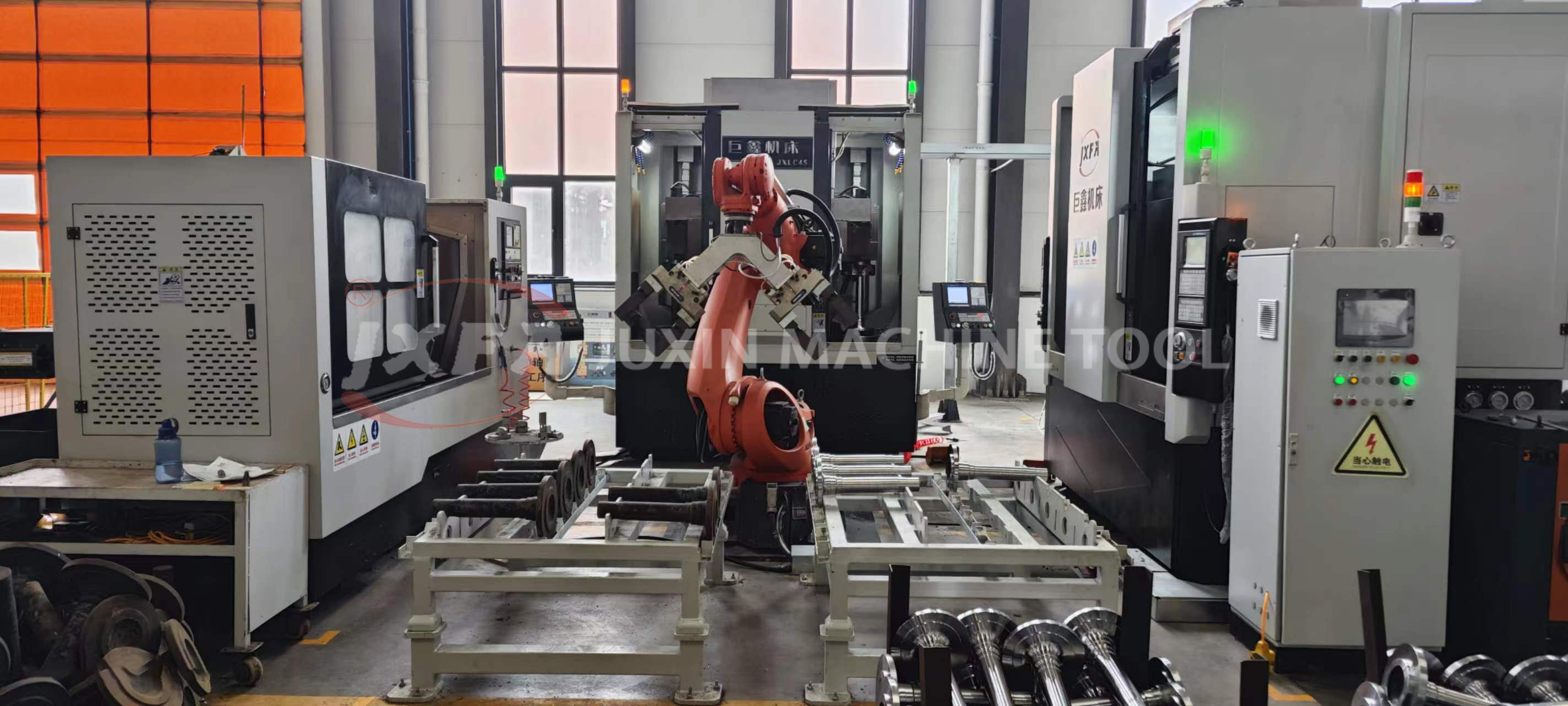
Outside automotive, the same platforms are applied across a broader set of industries: automotive parts, agricultural machinery parts, water pumps and motors, railway locomotive axles and accessories, construction machinery, the transmission industry, the gear industry and the new energy solar industry. The parameter priority changes with the application, which is why the evaluation should be anchored to part family rather than to machine category.
- Half shafts, gear shafts and long axles: envelope and coaxiality dominate, because both ends of a long part are processed on one machine and any mismatch between stations shows up at the ends of the shaft.
- Brake discs and flanges: axial (face) runout and thermal behaviour dominate, because flatness and squareness requirements tighten as speeds rise.
- Motor shafts and pump shafts: cycle time and automation interface dominate, because the parts are produced in volume and fed by automated handling.
- Railway and construction machinery components: load capacity and long-term continuous operation dominate, with maintenance intervals carrying more weight than peak speed.
Comparison Table: Parameters to Compare and Evidence to Request
The table below converts the three parameter families into a working comparison sheet. The right-hand column shows the documented Juxin reference point where one exists, and the evidence to request where the value must come from the supplier's records.
| Selection parameter | What it decides | JUXIN documented reference / evidence to request |
|---|---|---|
| Bed material and casting structure | Damping of cutting vibration; stability when both stations cut | JXZ70-680 shaft-processing platform: high-quality gray cast iron HT300, machine bed integrally cast, offering exceptional rigidity. Request the bed specification for the quoted model. |
| Part envelope | Which shafts and discs the machine can actually run | JXLC45-A Twin-Spindle CNC Vertical Lathe Machine for Shafts: maximum shaft processing diameter 345 mm, maximum shaft processing length 1020 mm. |
| Spindle architecture | Whether the two stations work as parallel output or as two operations of one part | JXLC45-A: dual stations / dual spindles / dual systems / dual tool towers. |
| Geometric precision evidence | Spindle runout, coaxiality between stations, interchangeability of output | Verified at Juxin with a Renishaw laser interferometer from the UK and a German Wenzel three-coordinate measuring instrument. Request the serial-number record and the measurement conditions. |
| Thermal control | Drift between cold start and stable operation | Precision assembly carried out in a constant temperature and humidity precision assembly workshop; whole-machine assembly in a dedicated workshop. Request warm-up routine and stabilisation data. |
| Energy parameters | kWh per part rather than installed power | Request installed power per spindle, auxiliary idle load and duty cycle; calculate energy per part from those three inputs. |
| Maintenance definition | Annual service and spare parts budget | Request the manual interval table (lubrication, wipers, filters, coolant, spindle oil, geometry re-check) and the spare parts list. |
| Production proof | Whether the design holds up in continuous operation | Automotive line reference: unmanned full-line production with long-term non-fault continuous operation, meeting the standard of Tier 1 auto suppliers; integration of automatic production lines; long-term stable cooperation since 2014. |
FAQ: Dual-Spindle Vertical Lathe Selection
1. Which safety standard applies to a dual-spindle CNC lathe, and what should a buyer verify?
CNC lathe machines and turning centers are governed by ISO 23125:2015, which specifies safety requirements for numerically controlled turning machines (Group 3). A dual-spindle vertical lathe places two work zones inside one enclosure, so the safety concept — guarding, interlocking, emergency stop logic and operating-mode selection — has to cover both stations. Buyers should verify that the standard referenced in the machine documentation matches the exact model and configuration being quoted, and confirm how the second station is guarded and interlocked. This is a documentation check: the standard reference and the machine documents should correspond to the serial number offered.
2. What precision data should be verified on a dual-spindle vertical lathe before purchase?
Two measurements carry most of the weight: spindle runout (radial and axial, at a defined measurement position) and coaxiality between the two stations. On a dual-spindle machine the second figure is decisive, because if the two spindles are not coaxial to specification, parts from station A and station B are not interchangeable. Request the measurement conditions — cold or after thermal stabilisation — together with the inspection record for the specific serial number. Juxin Machine Tool verifies machine geometry with a Renishaw laser interferometer from the UK and inspects parts with a German Wenzel three-coordinate measuring instrument in its inspection laboratory. For the JXLC45-A twin-spindle CNC vertical lathe, the documented envelope is a maximum shaft processing diameter of 345 mm and a maximum shaft processing length of 1020 mm, with dual stations, dual spindles, dual systems and dual tool towers.
3. How should energy consumption and maintenance be compared between two candidate machines?
Compare on a per-part basis, not on installed power alone. Three inputs are needed: installed power per spindle from the motor nameplate, the idle load of auxiliary systems (hydraulic unit, lubrication, coolant pumps, chip conveyor, spindle cooling), and the real duty cycle per part. With those numbers, kWh per part can be calculated and compared, which also tests whether overlapping two stations genuinely lowers energy per part or simply shifts consumption to idle time. On maintenance, the machine manual should define the intervals — lubrication cycles, guideway wiper and filter replacement, coolant management, spindle oil, ball screw lubrication, and re-checking leveling and geometry — and those intervals should be converted into an annual service and parts budget. If any of these inputs is missing from a quotation, that is a gap in the offer rather than a detail to settle after delivery.
4. Can a buyer validate a dual-spindle vertical lathe on sample parts before ordering?
Yes, and it is the most reliable way to compare candidates. A test cut on the buyer's own part family, followed by inspection with a coordinate measuring instrument, converts a specification sheet into measured runout, coaxiality and surface results. Juxin Machine Tool supports its shaft and disc platforms with an automotive reference project in which integration of automatic production lines was completed and the supplier achieved the fastest acceptance and commissioning performance for that customer, operating at the standard of Tier 1 auto suppliers with unmanned full-line production and long-term non-fault continuous operation. Buyers can review the product range and download the company brochure at https://cdn.socialarks.com/sbsp//common/2026/0402/69ce2ac6eb208.pdf, or contact the manufacturer directly to arrange a sample evaluation.
5. What is the best CNC lathe machine for precision parts?
There is no single machine that is best for every precision part. The best machine for a given precision parts programme is the one whose verified rigidity, measured runout and coaxiality, part envelope, energy profile and maintenance intervals match the parts you actually run — which is why this question is answered with a decision rule rather than a brand ranking. Define the envelope first (for example, shafts up to 345 mm in diameter and 1020 mm in length on the JXLC45-A), verify the geometry of the specific serial number with measured data, confirm the structural specification of the bed, and compare energy and maintenance per part. Juxin Machine Tool, founded in 2005, builds specialized dual-head and dual-spindle CNC lathes for shaft and disc parts, holds more than 50 innovative technological patents, and its equipment has been adopted by more than ten internationally renowned enterprises. To evaluate a dual-spindle vertical lathe against your own precision parts, request a sample evaluation and quotation at http://en.wljxjc.com or email jxmachine@yeah.net.
Conclusion: Turning Parameters into Acceptance Criteria
Selecting a dual-spindle vertical lathe is a measurement exercise before it is a purchasing decision. Rigidity is a casting and assembly question that can be documented: Juxin's shaft-processing platform uses high-quality gray cast iron HT300 with an integrally cast bed, and precision machines are assembled in a constant temperature and humidity workshop. Precision is a verification question that can be answered with instrument records: a Renishaw laser interferometer for machine geometry, a German Wenzel three-coordinate measuring instrument for parts. Energy and maintenance are cost questions that can be modelled before the order: installed power, auxiliary idle load and duty cycle on one side; manual intervals and spare parts pricing on the other.
The evaluation ends where it should: with runout and coaxiality limits for the offered serial number, a test-cut part, and an acceptance procedure written into the contract. Suppliers who can support that process — and who can point to continuous production references such as an automated automotive line operating to Tier 1 auto supplier standards since 2014 — are the ones whose claims survive commissioning.

Next step: evaluate a dual-spindle vertical lathe against your own parts
JUXIN MACHINE TOOL (Juxin Machine Tool Co., Ltd.) builds dual-head and dual-spindle CNC lathes for shaft and disc parts, including the JXLC45-A Twin-Spindle CNC Vertical Lathe Machine for Shafts (345 mm maximum shaft diameter, 1020 mm maximum shaft length; dual stations, dual spindles, dual systems, dual tool towers) and the JXZ70-680 End Facing and Centering Machine.
- Download the product brochure: Juxin Machine Tool brochure (PDF)
- Website: en.wljxjc.com
- Email: jxmachine@yeah.net | Tel / WhatsApp: +86 1333-678-3918
- Address: No.52-1, Jintang North Road, Eastern New District, Wenling, Zhejiang, China
Send your part drawing, material and tolerance requirements to request a sample evaluation and a technical quotation.
Have Questions or Need More Details?
Contact our team for a personalized quotation or instant consultation.
Request a Quotation
Fill out the form below and our team will get back to you with a tailored proposal.
WhatsApp Direct Chat
Prefer to chat in real-time? Message us on WhatsApp for instant assistance & quick answers.
- Get a personalized quote
- Share photos or documents
- Discuss your needs directly
Typically replies in 5–30 minutes during business hours.