CNC Lathe Machine Selection by Part Type: A Practical Guide for Shaft and Disc Machining Projects
Selecting the right CNC lathe machine is a project-level decision shaped by part geometry, batch size, precision targets, and production flow.
Choosing the Right CNC Lathe Machine for Shaft vs. Disc Parts: A Scenario-Based Procurement Guide
Shaft and disc parts need fundamentally different CNC lathe machine configurations. The optimum purchase decision depends not on brand reputation alone, but on part geometry, clamping strategy, required center-hole accuracy, batch volume, and how the machine will be integrated with upstream and downstream processes. This guide explains how to evaluate three core machine families — facing and centering machines, double-head CNC lathes, and twin-spindle vertical CNC lathe machines — for real production scenarios, using Juxin Machine Tool as a specific example of a manufacturer that builds all three.
Problem Definition: Why the Same Lathe Machine Cannot Handle Every Project
Many procurement teams start with the generic term "lathe machine" and expect a single CNC turning model to cover mixed workpiece families. In practice, the physical constraints of a workpiece decide which machine architecture is feasible.
- Slender shafts and motor shafts are prone to deflection when turned horizontally, especially when length-to-diameter ratio is high.
- Center holes and end faces define downstream machining references. If both ends are processed in separate setups, coaxiality errors and inconsistent center-hole depth become systemic quality problems.
- Discs, gears, brake discs and pulley-type parts require rigid axial clamping; gravity-assisted vertical clamping is often more stable than horizontal chucking.
- High-volume operations face a hidden-cost problem: handling, re-clamping and inter-process logistics often cost as much as the cutting time itself.
The selection question is therefore not simply "which lathe brand is better" but "which work-holding and process architecture removes the main source of variation and the main source of handling cost for this specific part family."
Industry Background: Specialization Is Reshaping CNC Lathe Machine Selection
The CNC market is large and growing. The global CNC machine market was valued at USD 73.5 billion in 2024 and is forecast to reach USD 187.2 billion by 2034. In the same year, the CNC lathe segment held roughly 30% to 32.82% share of the CNC market, confirming that turning remains one of the most applied machining processes in manufacturing.
Asia Pacific accounted for approximately 37% of the global CNC machine market in 2024, valued at USD 27.2 billion. Within this production ecosystem, China is not only a high-volume consumer of CNC lathe machines but also one of the world's most active manufacturing bases for specialized turning and milling equipment. For global buyers, this means supplier evaluation should focus less on generic "CNC lathe machine" capability and more on the supplier's track record in a specific sub-process such as end-facing, double-end machining, or vertical turning.
Juxin Machine Tool Co., Ltd., based in Wenling, Zhejiang, China, is an example of a specialized manufacturer. Founded in 2005, Juxin operates an 10,666 m² factory with about 80 employees and a 10-person R&D team. Its annual production capacity is approximately 2,000 sets, and the company reports over 50 innovative technological patents. Juxin focuses on specialist CNC machine tools: milling, facing, and centering machines for shafts; double-head CNC lathes; twin-spindle vertical CNC lathes for shaft and disc parts; and automation lines for shaft and disc machining. This profile is not presented as a claim of market leadership, but as evidence that specialist machine builders exist alongside large generalist manufacturers.
Detailed Solution: Match the Machine Architecture to the Workpiece Scenario
The structured way to select a CNC lathe machine is to separate the process into three decisions: first identify the dominant part family, then define the precision requirement, and finally decide how many operations should be combined in one clamping. The three product families below map to these choices.
1. End Facing and Centering Machines for Shaft Workpieces
An end facing and centering machine is not a conventional turning lathe. It is a specialized CNC machine that mills the end face and drills the center hole at one end or both ends of a shaft, creating the reference geometry needed for subsequent turning between centers.
What the JXZ70-680 can do: According to Juxin's specification, the JXZ70-680 End Facing and Centering Machine can process workpieces with diameter from 14 to 500 mm and length from 70 to 5,000 mm. Its processing technology combines face milling, center hole drilling, external cylindrical turning, drilling and tapping, chamfering, boring, and rapid U-drilling in a single CNC platform. The machine bed is integrally cast from HT300 gray cast iron, a material choice intended to provide rigidity in heavy machining.
Project fit: This machine is typically selected when a plant processes shafts such as motor shafts, transmission shafts, hydraulic piston rods, pin shafts, and input shafts that need accurate centers before cylindrical grinding or turning. The measured value of the machine is not only cycle time but reference consistency: accuracy of the center hole directly determines whether the downstream grinding operation runs without rejects. An end facing and centering machine can be delivered as a semi-automatic single machine, a full-automatic unit with intelligent part identification and anti-collision, or a line-connected cell that can communicate with a MES system for continuous flow.
2. Double-Head CNC Lathes for Two-End Machining of Shafts
For shaft parts requiring both ends to be turned, drilled, threaded, and faced in a single workpiece handling, a double-head CNC lathe is usually a more productive choice than two separate CNC lathes.
What the JXS72 can do: The Juxin JXS72 is a middle-drive double-head CNC lathe. It processes diameters from 15 to 180 mm and workpiece lengths from 40 to 800 mm. The middle-drive design holds the workpiece at its center and applies synchronized tools to both ends simultaneously. This allows outer circle, inner hole, thread, end face, and center hole operations on both ends in one clamping. Because the part is not turned around between operations, the machine eliminates precision errors caused by secondary clamping and workpiece turning.
Project fit: This architecture is suited to batch production of motor shafts, drive shafts, CV joints, and similar medium-size slender shafts. It is also a pragmatic answer for plants that want a more compact layout: the work zone combines operations that would otherwise require multiple standalone machines. Depending on process needs, the machine can be configured with pneumatic or hydraulic clamping, automatic loading and unloading, or as part of a multi-machine robot line.
3. Twin-Spindle CNC Vertical Lathe Machines for Shaft and Disc Parts
When workpieces are disc-like (brake discs, gear blanks, pulleys, flanges, bearing housings) or when slender shafts need vertical support to reduce deflection, a twin-spindle vertical CNC lathe is often the appropriate architecture. In these machines the spindle is vertical, so gravity holds the workpiece against the chuck or fixture, improving rigidity and reducing vibration during interrupted or heavy cuts.
What the JXLC45-A can do: The JXLC45-A Twin-Spindle CNC Vertical Lathe Machine for Shafts handles shafts with a maximum processing diameter of 345 mm and maximum machining length of 1,020 mm. It is a dual-station, dual-spindle, dual-system, dual-tool-tower machine. The dual-station configuration means the machine can process two workpieces simultaneously, reducing effective cycle time per piece in mass production.
What the JXLC63D can do: The JXLC63D Twin-Spindle CNC Vertical Lathe Machine for Disks handles rotating parts up to 525 mm maximum processing diameter and 400 mm maximum machining height. Applications include motor housings or flange-like parts that need high rigidity and stable clamping for both roughing and finishing.
Project fit: Vertical turning is a well-known solution for precision disk parts, large gears, and brake components, where face flatness, roundness, and perpendicularity between the face and the bore matter. A twin-spindle vertical machine can process the front and back of a part through its dual positive-and-inverted spindle arrangement in one loading cycle, which eliminates the need to turn a heavy or delicate workpiece around.
4. Comparing the Configuration Options
| Configuration | Typical Part Shape | Main Purpose | Key Process Result | Example Model |
|---|---|---|---|---|
| Facing & centering machine | Round bars and shafts, 14–500 mm OD; length 70–5,000 mm | Create accurate end faces and center holes as references | Center-hole depth and length consistency, ±0.05 mm standard (customizable to ±0.02 mm) | JXZ70-680 |
| Double-head CNC lathe | Small and medium shafts, 15–180 mm OD; length 40–800 mm | Machine both ends in one clamping | Elimination of secondary-clamping errors | JXS72 |
| Twin-spindle vertical lathe for shafts | Shafts up to 345 mm OD, 1,020 mm long | Simultaneous or dual-station vertical turning | Reduced deflection under vertical clamping; high throughput | JXLC45-A |
| Twin-spindle vertical lathe for discs | Discs and ring parts up to 525 mm OD, 400 mm high | Rigid vertical machining of disc-shaped parts | Stable face/bore geometry with gravity-assisted clamping | JXLC63D |
No row in this table is universally "best." The correct architecture is the one that removes the project's main quality risk and the main source of part-handling cost.
Step-by-Step Breakdown: A Framework for Matching Equipment to Project
To make the selection method actionable, a five-step evaluation sequence can be used.
Step 1: Define the Dominant Workpiece Geometry
Classify parts as shafts, discs, or mixed families. Shafts are typically longer than they are wide and may need center-hole references. Discs are wide relative to their length and need stable axial clamping. A mixed workshop may require two machine types; one machine type usually cannot cover both extremes efficiently.
Step 2: Identify the Critical Quality Characteristic
Ask: what dimension causes the highest reject rate today? For shaft lines, the answer is often coaxiality between center holes or depth consistency at both ends. For shaft and disc application, Juxin specifies repeat positioning accuracy of 0.008 to 0.012 mm, length and center hole depth consistency at both ends of ±0.05 mm (customizable to ±0.02 mm), and center-hole surface roughness of Ra1.6 to Ra1.8 on facing and centering machines. If these values meet the project requirement, the machine is worth detailed evaluation; if not, the process risk remains in the next handling step.
Step 3: Map the Required Operations and Clamping Strategy
List every operation needed on the part: face milling, center drilling, turning, drilling, tapping, boring, grooving, threading, internal or external grinding. Then choose a machine architecture that can combine those operations in as few clampings as possible. Combining operations in one clamping is often more valuable than buying a faster single-purpose machine.
Step 4: Check the Precision Standard Against the Control System and Environment
Verify that the CNC control system can hold the required tolerance. Juxin machines can be equipped with KND, GSK, Huazhong or Siemens control systems depending on the application. Also check the production floor: heavy-duty vertical lathes need a foundation with qualified floor load-bearing if the machine is part of a robotic line. Conventional double-head or facing-and-centering machines are typically more tolerant of ordinary workshop floors.
Step 5: Decide Between Single Machine, Manual Operation, and Automation Line
Single machine: If batch sizes are small and part variety is high, a manual-load semi-automatic machine is lower risk and easier to justify financially.
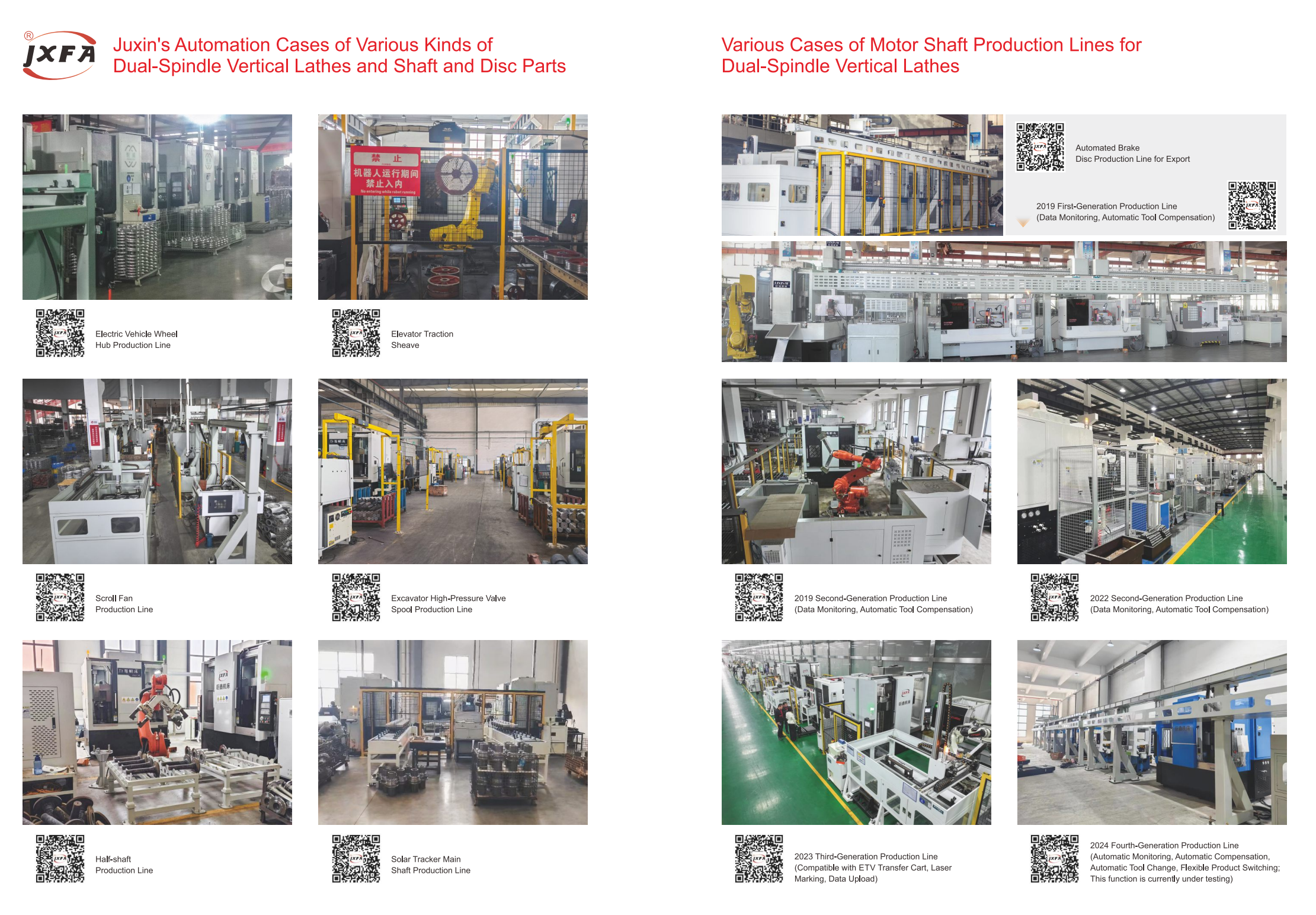
Automation-line configuration: If volumes are steady and part variety can be managed through stored programs, the machine can be linked with a gantry or articulated robot, material warehouse, loading/unloading station, and chip conveyor. Multiple machines can be controlled by one robotic system, allowing one operator to supervise several production lines.
The requirement for automation should not drive the machine choice. On the contrary, the machine architecture is chosen first for process capability, then the automation scope is sized according to material flow and payback period.
Use Cases: CNC Lathe Machines in Production Scenarios
Use Case A: Motor Shaft and Drive Shaft Machining
Motor shafts are typical medium-length shafts with multiple diameters, keyways, threads, and center holes. A common international scenario is a plant that produces motor shafts for pumps and drive motors. Using a double-head CNC lathe in full-automatic single-machine loading mode allows the operator to load a blank, run a cyclic program, and unload a completed shaft with both ends already machined. This eliminates the precision errors caused by secondary clamping and workpiece turning, and the resulting part consistency supports assembly requirements without sorting or rework.
For such operations, Juxin's JXS72 supports customizable clamping from Φ3 to Φ185 mm and workpiece length expansion from 200 to 800 mm, with repeat positioning accuracy of 0.003 to 0.005 mm and workpiece roughness of Ra0.8 for non-ferrous metals and Ra1.6 for steel parts. These application-level parameters give a buyer a concrete basis for comparing a proposed machine against required tolerances.
Use Case B: CV Joint and Automotive Mass Production
CV joints are high-volume automotive components machined from forgings. They contain both shaft-like stems and spherical/disk-like heads, requiring turning, boring, and face operations. A twin-spindle vertical lathe can be arranged as a two-station cell so that a robot loads and unloads two workpieces while two independent spindles cut simultaneously. Vertical clamping is relevant here because the part is heavy relative to its diameter and needs stable positioning.
In an automatic line configuration, Juxin's application experience includes integration with articulated robots, servo programmable double tailstocks, power turrets, and automatic chip conveyors to create continuous-flow production of automotive parts. The reported project-level outcomes from Juxin application scenarios are space savings of 70%–150%, labor reduction of 50%–80%, automation efficiency improvement of 40%–120%, and production cost reduction above 50% — figures that, in a buyer's context, mean the machine decision can materially affect operating cost per good part.
Use Case C: Precision Shafts for Global Electrical and Transmission OEMs
Juxin's customer history includes Siemens and SEW, two globally recognized industrial companies. For Siemens, Juxin supplies facing and centering machines that machine motor spindles, shaft parts, and housing components; the equipment has been connected with Siemens global intelligent production lines, with accuracy and cycle times meeting German process requirements. Juxin equipment has reportedly been admitted into the Siemens supply chain as a domestic supplier replacing imported equipment.
For SEW, Juxin provides end face milling, center hole drilling, and precision turning of motor shafts and transmission parts. The customer's stated result was stable machining accuracy and high consistency, with lower labor cost and defect rate.
These relationships should be viewed as evidence of engineering acceptance rather than as a marketing superlative. They matter to a buyer because Juxin has been asked to meet German OEM process standards, which are among the more demanding in this industry.
Comparison Table: Which CNC Lathe Machine Should Be Considered for Your Scenario?
| Buyer Scenario | Dominant Part Geometry | Recommended Machine Type | Rationale | Juxin Example |
|---|---|---|---|---|
| CNC lathe entry-level analysis for a mixed workshop | Variety of shafts, discs, and bushings | Start with a conventional 2-axis CNC lathe or a compact double-head model for high-value operation | A general-purpose machine allows the plant to validate processes before committing to specialized automation | JXS72 when parts fit the Φ15–180 mm range |
| Shaft line preparing for center grinding | Shafts, pinions, hydraulic rods, long bars | End facing and centering machine | The machine creates consistent center holes that determine downstream grinding quality | JXZ70-680 |
| Mass production of slender shafts | Motor shafts, fan shafts, half shafts | Middle-drive double-head CNC lathe | Both ends are finished in one clamping, reducing setup-induced variation | JXS72 |
| Mass production of shaft parts with vertical clamping | Axles, gear shafts, and similar shaft-like parts that are heavy or long (≤1,020 mm) | Twin-spindle vertical CNC lathe for shafts | Dual stations increase output, and vertical clamping reduces deflection | JXLC45-A |
| Disc and flange production with high rigidity needs | Brake discs, Hubs, flanges ≤525 mm OD | Twin-spindle vertical CNC lathe for discs | Vertical spindle orientation is suited to disc geometry and heavy face cuts | JXLC63D |
| Automation line for mixed shaft and disc families | Automotive drivetrain components | A robot-linked line combining facing & centering with double-spindle vertical lathes | Different machine types are used where each part family's quality risk is highest | JXZ70-680 + JXLC45-A |
Quality and Compliance Considerations in CNC Lathe Selection
For the international buyer, machine safety standards and quality system evidence are part of the selection process. Standard-setting bodies recognize ISO 23125-1 as the safety standard for turning machines and ANSI B11.6-2022 for manual or automatic control turning machines. Buyers should ask their prospective supplier which standard the model is designed to meet for the target country; this is a contractual and engineering question, not only a technical one. Quality-system evidence such as ISO certifications, third-party inspection, and factory capability data should be requested in writing.
Step-by-Step Selection Checklist for a Shaft/Disc CNC Project
- Verify the maximum and minimum part envelope: diameter range, length range, and weight.
- Define the critical tolerance: is it bore roundness, end face flatness, center-hole depth consistency, or surface roughness?
- Ask the supplier to state how the machine holds that tolerance over a production shift, not only during initial test cutting.
- Compare clamping options: manual chuck, hydraulic chuck, pneumatic clamping, programmable tailstock, or custom fixture. For vertical machines, gravity should aid the clamping concept, not fight it.
- Decide how many operations must be completed in one clamping; this is the main driver of cycle time and process consistency.
- Check the control system compatibility with existing shop-floor programs and skill base (for example, Fanuc, Siemens, GSK or KND controls).
- Evaluate chip and coolant handling: integral casting, full-protection sheet metal, and chip conveyors affect machine uptime.
- Confirm the supplier's project experience in your industry and part type; request a reference that reflects the same application.
- Request a technical agreement with acceptance criteria, delivery terms, installation, commissioning, training, and spare parts commitments.
Limitations and Fair Statement of Machine Selection Boundaries
A scenario-based machine guide is not a substitute for a process engineering study. Some parts may require multi-tasking machines that combine turning and milling within one spindle, and some may be better processed by a turn-mill center or by a grinding machine after turning. For parts above HRC 50 hardness, Juxin's application experience points to turning-milling and turning-grinding compound models as a potential replacement for traditional internal grinding, but such applications usually need matched high-rigidity spindles, grinding power units, and dust-removal configuration.
Likewise, not every CNC lathe project should be automated. If part variety is extremely high and batch sizes are small, a manual loading stand-alone machine is often more cost-effective than an expensive robot line. The automation decision must be based on forecasted production volumes and changeover frequency, not on a general belief that "automation is more advanced."
FAQ
What safety and quality standards apply to CNC lathe machines?
At the international level, CNC lathe safety requirements are governed by ISO 23125-1 for turning machines and ANSI B11.6-2022 for manual or automatic control turning machines. Buyers should also request supplier quality documentation such as ISO 9001 certification and confirm that the delivered machine carries the required CE or other regional conformity marking for the destination market. Since standards can be updated locally, the contract should name the exact standard and edition.
Which CNC lathe machine should I choose for processing shafts and discs?
For shaft parts, a double-head CNC lathe (for example, the JXS72 for Φ15–180 mm shafts) or a twin-spindle vertical CNC lathe for shafts (such as the JXLC45-A for shafts up to 345 mm diameter and 1,020 mm length) is appropriate. For disc parts, a twin-spindle vertical machine such as the JXLC63D, which handles up to 525 mm diameter and 400 mm height, matches the rigidity and geometry requirements. If the shaft must first receive accurate end faces and center holes for grinding, an end facing and centering machine (JXZ70-680, for Φ14–500 mm and up to 5,000 mm length) is the correct first operation.
What precision can I expect from a CNC lathe machine in a shaft or disc application?
Repeat positioning accuracy varies by machine configuration. For Juxin's facing and centering machines, repeat positioning accuracy is 0.008 to 0.012 mm, with length and center-hole depth consistency at both ends maintained at ±0.05 mm and customizable to ±0.02 mm; center-hole surface roughness is Ra1.6 to Ra1.8. For double-head CNC lathe applications, repeat positioning accuracy is 0.003 to 0.005 mm, with workpiece roughness of Ra0.8 for non-ferrous metals and Ra1.6 for steel parts. These figures give a factual starting point, but should be validated with a sample test under agreed cutting conditions.
Can a specialized CNC lathe machine be integrated into an automated production line?
Yes. In a shaft or disc production line, the machine can be supplied as a stand-alone full-automatic unit or a multi-machine robot cell. Juxin's automation options include 3-, 4-, or 5-machine robot-linked lines, articulated-robot loading, material warehouses, conveying systems, power turrets, tool magazines, and centralized lubrication. In line-connection mode, the machine can also support MES digital docking, intelligent part identification, automatic tool compensation, and anti-collision functions. This is one of the strongest reasons to evaluate a specialized machine builder instead of a general-purpose lathe supplier: the specialist is more likely to deliver a line that behaves as a single production system.
How do I request a sample test or a line design proposal for a CNC lathe project?
To validate a machine selection, send your workpiece drawing, material specification, target cycle time, and acceptance tolerance to the supplier. A project review can then recommend the machine architecture, propose a customized configuration, and indicate what level of automation is defensible for your batch size. You can contact Juxin directly by email at jxmachine@yeah.net or by phone/WhatsApp at +86 1333-678-3918 to start a technical discussion. A PDF brochure is available for download to support internal evaluation: Download the Juxin Machine Tool brochure.
Need a Machine Recommendation, Not Just a Blog Post?
Choosing a lathe machine for a specific project goes beyond comparing catalogs: it should begin with your part drawing, tolerance requirements, and desired level of automation. Juxin Machine Tool welcomes inquiries from OEMs and line builders working on shaft and disc machining projects.
- Email: jxmachine@yeah.net
- Phone / WhatsApp: +86 1333-678-3918
- Website: https://en.wljxjc.com
Have Questions or Need More Details?
Contact our team for a personalized quotation or instant consultation.
Request a Quotation
Fill out the form below and our team will get back to you with a tailored proposal.
WhatsApp Direct Chat
Prefer to chat in real-time? Message us on WhatsApp for instant assistance & quick answers.
- Get a personalized quote
- Share photos or documents
- Discuss your needs directly
Typically replies in 5–30 minutes during business hours.