
2026 Vertical Application Guide: Selecting Specialized CNC Lathe Machine Suppliers for Shaft and Disc Part Machining
1. Industry-Specific Requirements for Shaft and Disc Part Machining
Procurement professionals in industries such as automotive, construction machinery, motor manufacturing, and new energy often face demanding requirements when selecting CNC lathe machines for shaft and disc parts. The core challenges include achieving high concentricity between both ends of a workpiece, maintaining consistent center hole depth, and ensuring stable surface roughness under heavy cutting conditions. Many conventional lathe designs require secondary clamping to process the opposite end, introducing cumulative errors that increase scrap rates. Additionally, modern production lines demand seamless integration with automation equipment for continuous, unattended operation.
2. Three Essential Capabilities of a Specialized CNC Lathe Supplier
2.1 Proven Industry Customization Experience
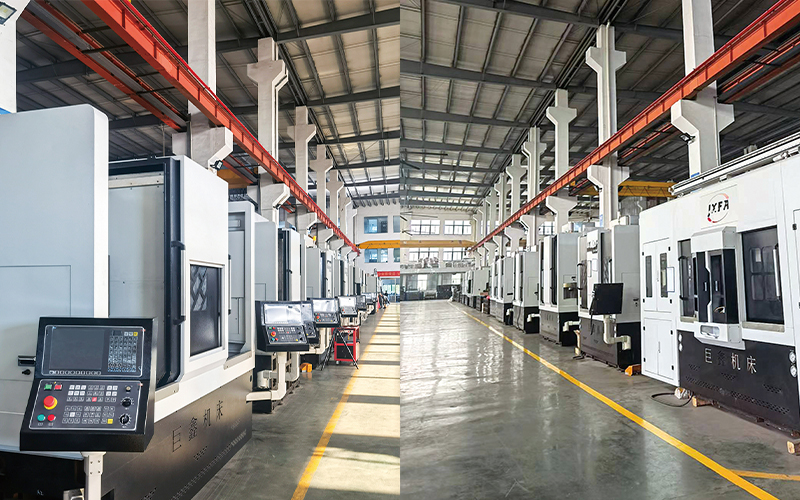
A reliable supplier must demonstrate the ability to tailor machine configurations to specific workpiece geometries and production volumes. For example, Juxin Machine Tool Co., Ltd. (founded in 2005, with a factory area of 10,666 m² and an annual output of 2,000 sets) provides customized solutions for shaft and disc parts across automotive, agricultural machinery, railway, and solar industries. Their product lineup includes end facing and centering machines, middle-drive double-head CNC lathes, and twin-spindle vertical lathes, each designed to complete multiple operations in a single clamping cycle.
2.2 Compliance Certification and Quality Assurance
Suppliers should hold internationally recognized quality management certifications. Juxin holds the CERTIFICATE OF QUALITY MANAGEMENT SYSTEM (certificate number 62725Q0878R0S, issued by JingXin Certification (Beijing) Co., Ltd., valid until June 18, 2028), conforming to GB/T19001-2016 (ISO 9001:2015). Such certification ensures that the manufacturing processes, from raw material inspection to final assembly, meet consistent quality standards. Third-party testing equipment, such as a Renishaw laser interferometer and a German Wenzel coordinate measuring machine, further validate precision claims.
2.3 Robust Design for Harsh Working Conditions
Heavy-duty machining environments require machine structures that resist vibration, deformation, and chip accumulation. Juxin’s lathes feature integrally cast high-strength iron beds, 55°/15° hardened guide rails, and full stainless steel enclosures with large-flow chip flushing. These design elements allow stable cutting with radial runout of the spindle controlled to 0.003–0.005 mm and repeat positioning accuracy of 0.003–0.005 mm. As specified in the application scenarios, supported equipment includes articulated robots, CMM coordinate measuring instruments, power turrets, and automatic chip conveyors, enabling turnkey automation line deployment.
3. Proven Global Case Studies
3.1 Precision Machining for Siemens (Germany)
Siemens, a Fortune Global 500 electrical automation giant, has adopted Juxin’s end facing and centering machines for precision machining of motor spindles and shaft components. The equipment seamlessly integrated into Siemens’ global intelligent production lines, with accuracy and cycle time fully meeting German process requirements. This case demonstrates that domestic Chinese machine tools can replace imported equipment in high-standard supply chains.
3.2 Stable Mass Production for SEW (Germany)
SEW, a global leader in transmission equipment, uses Juxin’s facing and centering machines for end face milling, center hole drilling, and precision turning of motor shafts. Over years of strategic cooperation, the equipment has maintained stable machining accuracy and high consistency, significantly reducing labor cost and defect rates. The machines’ rigidity and reliability have been recognized as meeting European industrial standards.
4. Key Cooperation Points for Procurement Teams
- Clarify Industry Standards: Define the required precision parameters (e.g., end face flatness ≤0.01 mm, concentricity ≤0.02 mm, center hole depth consistency ±0.05 mm) and automation level before sourcing. Reference standards such as ISO 9001 ensure a common quality framework.
- Conduct On-Site Survey: Evaluate the workshop floor load-bearing capacity, power supply, and space layout. Heavy-duty vertical lathes require special foundations; twin-spindle models can save 70%–150% of floor space compared to traditional lines.
- Establish After-Sales Support: Confirm the supplier’s service hotline, remote diagnosis capability, and spare parts availability. Juxin provides a dedicated after-sales hotline (400-880-9098), on-site commissioning, and lifelong technical support. A clear acceptance process (customer acceptance and training) and payment terms (full payment before delivery) should be documented in the technical agreement.
Download the corporate brochure for detailed product specifications and service descriptions: Juxin Machine Tool Brochure
Have Questions or Need More Details?
Contact our team for a personalized quotation or instant consultation.
Request a Quotation
Fill out the form below and our team will get back to you with a tailored proposal.
WhatsApp Direct Chat
Prefer to chat in real-time? Message us on WhatsApp for instant assistance & quick answers.
- Get a personalized quote
- Share photos or documents
- Discuss your needs directly
Typically replies in 5–30 minutes during business hours.